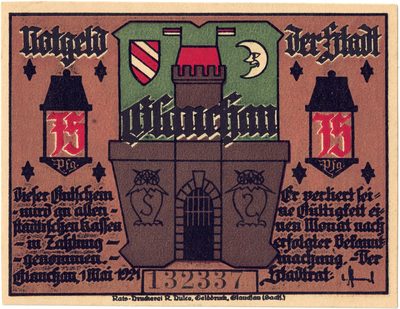
Types / 1921
75 Pfennig, Stadt Glauchau, 1921 (beer-war silhouette, sheet 3)
Notgeld der Stadt Glauchau
What was happening
By 1920 German Notgeld had stopped being a response to a coin shortage and become a collector's product. Towns, districts and firms commissioned decorative Serienscheine - lithographed sets printed far beyond any local need and sold to collectors, illustrated with whatever the place was proud of: a legend, a famous son, a battle, a trade, a joke in dialect. The result is the most inventive body of graphic design in the history of paper money, made in the years when Germany's currency was dying.
Glauchau, a manufacturing town in Saxony, was the home of the Ratsdruckerei R. Dulce, which printed decorative Notgeld for towns all over Germany. For its own 75-Pfennig notes Dulce produced a set of cut-paper silhouettes (Scherenschnitte) telling, scene by scene and in rhymed Saxon couplets, the mock-heroic story of the Glauchau-Meerane "beer war" - a comic feud between the two neighbouring textile towns over their rival brews. The obverse is identical across the set: the town arms with their crescent, flanked by two gate-towers, over Notgeld der Stadt Glauchau and the serial number. Each numbered reverse carries one black-silhouette scene of the quarrel.
This is sheet 3 of the set.