Types / 1921
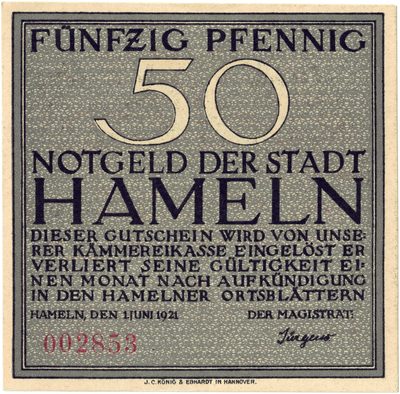
50 Pfennig, Stadt Hameln, 1921 (Pied Piper)
Notgeld der Stadt Hameln
What was happening
Hameln (Hamelin), on the Weser in Lower Saxony, is known the world over for one story. In the legend, a piper in motley ("pied") clothing rid the rat-plagued town of its rats by luring them into the Weser with his pipe; when the town refused to pay him, he returned and piped away its children — in the usual telling 130 of them, on 26 June 1284 — who followed him out of town and vanished. The oldest records mention only the lost children, not the rats, which were added centuries later; historians read the "children" as young settlers led east in the medieval colonisation, or as victims of plague or disaster. The Brothers Grimm and Robert Browning fixed the tale in its modern form.
In the inflation years Hameln, like every German town with a story to tell, put that story on its emergency money. This note belongs to the town's first 1921 issue — a plain typographic front reading "NOTGELD DER STADT HAMELN", the value, and the promise that the town treasury (Kämmereikasse) would redeem it, dated Hameln, 1 June 1921, signed by the magistrate Jürgens, with a red serial number; printed by J. C. König & Ebhardt of Hannover. The reverse carries the Pied Piper. It is the 50-Pfennig value of a four-note set that also included 75 Pfennig and 1 Mark (the Mark note instead showing the monument to Hamelin's famous 1600 septuplets).