Types / 1918
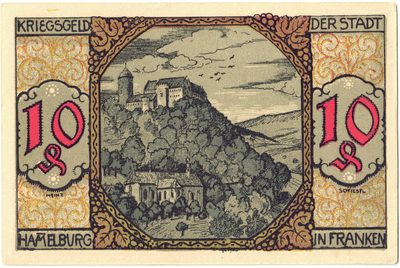
10 Pfennig, Kriegsnotgeld of Hammelburg, 1918
Kriegsgeld der Stadt Hammelburg in Franken
What was happening
This is Kriegsnotgeld - war emergency money, not the collectors' Notgeld of 1920-21 that followed it. Within weeks of mobilisation in 1914 silver and nickel coin vanished from circulation into hoards, and the Reichsbank could not supply enough small notes to replace it. Towns, districts and firms filled the gap themselves, on their own authority, redeemable against their own treasuries.
These early issues look like what they are: functional paper, serially numbered, with a validity tied not to a date but to the end of a war nobody could date.
Hammelburg is a small wine town on the Franconian Saale, and claims to be the oldest wine town in Franconia. Its ten-Pfennig note is dated 10 March 1918 and promises validity "for six months after the conclusion of peace" - a formula that in March 1918 still sounded like a date. The note carries a serial number and the signatures of the mayor and the board of the municipal collegium.
The face shows the castle of Saaleck above vineyards, drawn by the pair who signed most of Lower Franconia's emergency money: the brothers-in-arms Heinz and Schiestl, whose monograms appear in the corners of notes from Hammelburg, Coesfeld and Aschaffenburg alike.