Types / 1921
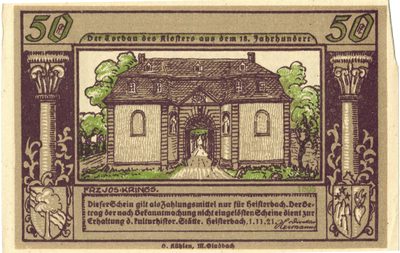
50 Pfennig, Heisterbach Abbey, 1921
Heisterbach im Siebengebirge
What was happening
By 1920 German Notgeld had stopped being a response to a coin shortage and become a collector's product. Towns, districts and firms commissioned decorative Serienscheine - lithographed sets printed far beyond any local need and sold to collectors, illustrated with whatever the place was proud of: a legend, a famous son, a battle, a trade, a joke in dialect. The result is the most inventive body of graphic design in the history of paper money, made in the years when Germany's currency was dying.
Heisterbach is a ruined Cistercian abbey in the Siebengebirge above Koenigswinter on the Rhine. Founded at the end of the twelfth century and its great church consecrated in 1237, the monastery was dissolved in the secularisation of 1803; the Napoleonic Berg administration then sold the church for building stone, and only the fragment of the choir still standing was spared - one of the most romantic ruins in the Rhineland, and the subject of Wolfgang Mueller's legend of the monk of Heisterbach. This note was valid only at Heisterbach, its proceeds going to the upkeep of the site; the gatehouse on the obverse is signed Frz. Jos. Krings.