Types / 1921
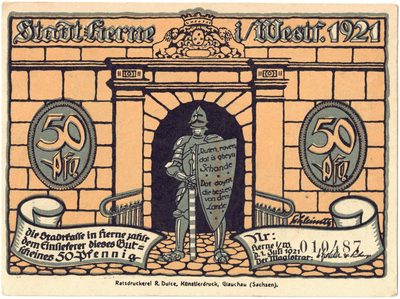
50 Pfennig, Stadt Herne, 1921
Notgeld der Stadt Herne i. Westf.
What was happening
Notgeld began in 1914 out of necessity: coin vanished into hoards within weeks of mobilisation and towns printed their own small change because the Reichsbank could not supply enough.
By 1920 it had become something else. The shortage was easing but the collector market was not, and a town could take real marks for paper it hoped would never be presented. So the municipalities commissioned Serienscheine: lithographed sets, printed far beyond any local need, illustrated with whatever the place was proud of - a legend, a famous son, a battle, a joke in dialect. The result is the most inventive body of graphic design in the history of paper money, made by places with a few thousand inhabitants, in the years when Germany's currency was dying.
Herne sits in the middle of the Ruhr, a coal town that grew from a village to eighty thousand people in fifty years. Its 1921 set is unusually pointed. Two of the notes carry a couplet about reparations - solang' zahl'n wir dem Franzmann Gold, bis dies Papier verdrängt durch Gold - as long as we pay the Frenchman gold, until this paper is driven out by gold again - and the reverses are not a castle or a saint but a map of the Rhein-Herne canal, with Duisburg, Dortmund and Emden marked and the chimneys smoking behind it.
The historical notes are blunter still. Duten, roven, dat is gheyn Schande, dat doynt die besten von dem Lande: robbing and plundering is no disgrace, the best in the land do it.
This is the 50 Pfennig; its reverse shows a knight on horseback confronting a burgher outside the town, numbered 1 in the corner, under a Low German verse about a bad time at Riadelhusen.