Types / 1921
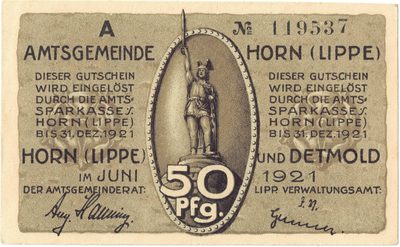
50 Pfennig, Amtsgemeinde Horn (Lippe), 1921
Amtsgemeinde Horn (Lippe)
What was happening
Notgeld began in 1914 out of necessity: coin vanished into hoards within weeks of mobilisation and towns printed their own small change because the Reichsbank could not supply enough.
By 1920 it had become something else. The shortage was easing but the collector market was not, and a town could take real marks for paper it hoped would never be presented. So the municipalities commissioned illustrated notes, printed far beyond any local need and decorated with whatever the place was proud of. The result is the most inventive body of graphic design in the history of paper money, made in the years when Germany's currency was dying.
Horn, in the little principality of Lippe, sits just below the Teutoburg Forest, and its note reaches for the largest story in the neighbourhood. Its obverse carries the Hermannsdenkmal, the colossal monument to Arminius (Hermann) raised on a wooded hilltop near Detmold and finished in 1875: a copper figure with sword lifted, built on the belief that the forest nearby was where the Germanic tribes destroyed three Roman legions. The reverse shows that battle itself - the Varusschlacht of 9 AD, in which Arminius ambushed and annihilated the legions of Publius Quinctilius Varus in the Teutoburg Forest - under a comic Low-German caption drawn from Joseph Victor von Scheffel's student song: "Als die Römer frech geworden... met der grauden, frechen Schnuden" (roughly, "when the Romans got cheeky... with their great cheeky snout").
The note is series letter A, serial 119537, dated "Horn (Lippe), im Juni 1921," and was redeemable at the Amts-Sparkasse Horn until 31 December 1921.