Types / 1921
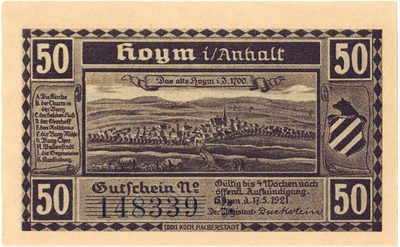
50 Pfennig, Stadt Hoym in Anhalt, 1921
Gutschein der Stadt Hoym i. Anhalt
What was happening
Notgeld began in 1914 out of necessity: coin vanished into hoards within weeks of mobilisation and towns printed their own small change because the Reichsbank could not supply enough.
By 1920 it had become something else. The shortage was easing but the collector market was not, and a town could take real marks for paper it hoped would never be presented. So the municipalities commissioned Serienscheine: lithographed sets, printed far beyond any local need, illustrated with whatever the place was proud of - a legend, a famous son, a battle, a joke in dialect. The result is the most inventive body of graphic design in the history of paper money, made by places with a few thousand inhabitants, in the years when Germany's currency was dying.
Hoym is a small town in Anhalt, on the northern edge of the Harz. Its 1921 vouchers are numbered, valid four weeks after the public call, printed by Louis Koch of Halberstadt, and signed by a magistrate named Duckstein.
The face of every note is the same: a long low prospect captioned das alte Hoym i. J. 1700, the town as it stood in 1700, with a keyed list of its buildings down the left side - the church, the tower in the churchyard, the Oberdorf, the town hall, the Burgmühle, the Burgtor. A place explaining itself to itself.
This note's reverse shows the raising of the village of Hoym to the rank of a town in 1546, in a framed scene with the arms of Anhalt above it.