Types / 1921
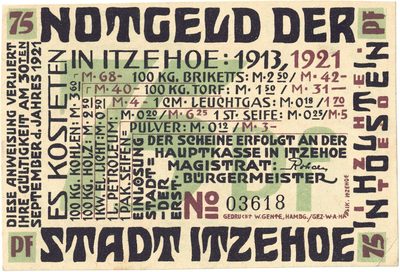
75 Pfennig, Stadt Itzehoe, 1921 (Wat mutt, dat mutt)
Notgeld der Stadt Itzehoe
What was happening
Itzehoe is a market town on the Stör in Holstein, one of the oldest settlements in the region. This 75-Pfennig note is a Serienschein of 1921, and an unusually good one, because it was designed by Wenzel August Hablik (1881–1934) — a significant German Expressionist painter, architect and designer who settled in Itzehoe in 1907 and died there. Hablik belonged to Bruno Taut's utopian "Glass Chain" circle and is famous for visionary crystalline architecture; the town's Wenzel-Hablik-Museum holds his estate. He signed this note "Gez. W. A. Hablik, Itzehoe".
One face is pure graphic bravado: a great crowing rooster over the Low-German mottoes "Wat mutt, dat mutt" ("what must be, must be") and "Ist ok keen Gold, is dat doch Geld!" ("it may be no gold, but it is money"), a wry defence of paper emergency money. The other face is a dense typographic panel — "NOTGELD DER STADT ITZEHOE", the value, a serial number, the first mayor's signature, and the validity to 30 September 1921 — wrapped around a price list headed Es kosteten … in Itzehoe: 1913 / 1921, comparing the pre-war and post-war cost of coal, wood, petroleum, gas, soap and the like. A hundred kilograms of coal that cost 3.60 marks in 1913 cost 68 in 1921.
That "then and now" price list is a recognised sub-genre of inflation Notgeld: part civic commentary on what the money had come to, part sales gimmick for the collectors who bought these notes. Printed by W. Gente of Hamburg.