Types / 1921
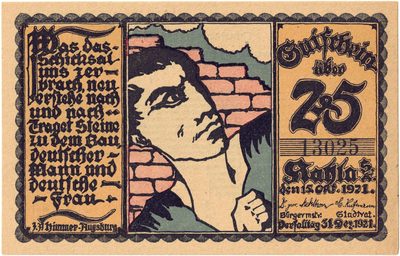
25 Pfennig, Stadt Kahla, 1921 (Bewertung fremder Banknoten)
Gutschein der Stadt Kahla S.-A.
What was happening
Notgeld began in 1914 out of necessity: coin vanished into hoards within weeks of mobilisation and towns printed their own small change because the Reichsbank could not supply enough.
By 1920 it had become something else. The shortage was easing but the collector market was not, and an issuer could take real marks for paper it hoped would never be presented. So towns, firms and clubs commissioned Serienscheine: lithographed sets, printed far beyond any local need, illustrated with whatever the place was proud of - a legend, a famous son, a battle, a trade, a joke in dialect. The result is the most inventive body of graphic design in the history of paper money, made in the years when Germany's currency was dying.
Kahla is a porcelain town on the Saale in the old duchy of Sachsen-Altenburg - the "S.-A." on its notes - below the Leuchtenburg, a hilltop castle the town and the surrounding Land Altenburg were turning into a war memorial after 1918. In 1921 Kahla and the private bodies around it put out one of the richest Notgeld programs in Thuringia: municipal Gutscheine in several themed sets, the castle inn's own vouchers, a chess congress and a sports tournament. The whole output is catalogued together under Grabowski and Mehl number 668, and nearly every note pairs a common value side with a different picture on the back.
These are the 'rebuilding' notes, issued 15 October 1921. The face is a triptych: the mason's verse Was das Schicksal uns zerbrach, neu erstehe nach und nach - traget Steine zu dem Bau, deutscher Mann und deutsche Frau, a worker set against a broken brick wall, and the value panel. The back carries a statistic of the defeated economy - a Deutsche Wirtschaftskurve - turning emergency money into post-Versailles argument.