Types / 1921
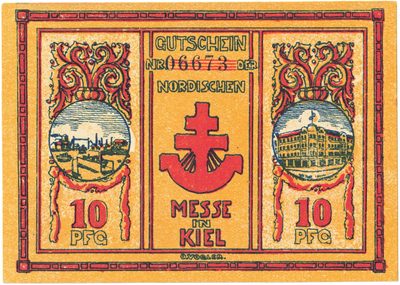
10 Pfennig, Nordische Messe Kiel, 1921
Nordische Messe in Kiel
What was happening
Notgeld began in 1914 out of necessity: coin vanished into hoards within weeks of mobilisation and towns printed their own small change because the Reichsbank could not supply enough.
By 1920 it had become something else. The shortage was easing but the collector market was not, and an issuer could take real marks for paper it hoped would never be presented. So towns, firms and bodies of every kind commissioned Serienscheine and occasion notes: lithographed sets printed far beyond any local need and illustrated with whatever the place was proud of. The result is the most inventive body of graphic design in the history of paper money, made in the years when Germany's currency was dying.
This note is one of a set of emergency vouchers struck for the Nordische Messe (Nordic Trade Fair) held at Kiel, the Baltic harbour and naval town that is the capital of Schleswig-Holstein, in September 1921. Fairs of this kind sprang up across Germany in the hard post-war years to draw trade - the note was valid as small change during the fair (13-18 September 1921) and redeemable afterwards at the Kieler Spar- und Leihkasse until 15 October 1921. The design is by O. Vogler and carries Low-German verses in keeping with the Nordic theme. Its companion is the 50-Pfennig value; see [[notgeld-kiel-nordische-messe-50-pfennig]].