Types / 1918
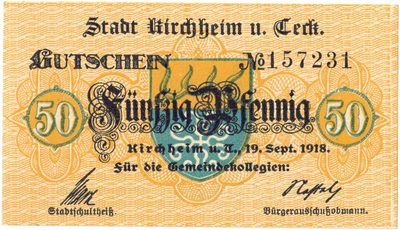
50 Pfennig, Stadt Kirchheim unter Teck, 1918
Gutschein der Stadt Kirchheim unter Teck
What was happening
Notgeld - "emergency money" - began in 1914, not as a collector's craze but out of hard necessity. Within weeks of mobilisation the small silver and copper coin disappeared: people hoarded metal, and the Reichsbank could not supply enough change for daily trade. Towns, districts and firms stepped in and printed their own low-value notes to keep shops and wage packets working. This early, austere wartime money is called Kriegsnotgeld to distinguish it from the lavishly illustrated collector Serienscheine that flooded out after 1920.
Kirchheim unter Teck is a Württemberg town in the foreland of the Swabian Alb, named for the Teck - the ruined hill-castle of the dukes of Teck that rises above it. Long a market and weaving town on the roads between the Neckar and the Alb, it issued this 50-Pfennig note on 19 September 1918, in the last autumn of the war, when the coin shortage was at its worst.
The note is plain and functional: the town arms, the value in Fraktur, and two signatures - the Stadtschultheiß (the mayor, in the old Württemberg title) and the chairman of the citizens' committee (Bürgerausschußobmann). Like most wartime municipal notes it was declared valid only "bis 6 Monate nach Friedensschluß" - until six months after the conclusion of peace - so that it would cease to be money once normal coin returned. It was lithographed by Gebr. Paschl in Munich.