Types / 1921
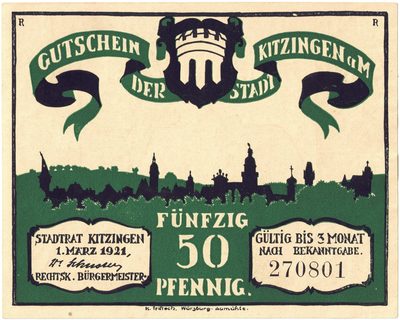
50 Pfennig, Stadt Kitzingen, town silhouette, 1921
What was happening
Notgeld began in 1914 out of necessity: coin vanished into hoards within weeks of mobilisation and towns printed their own small change because the Reichsbank could not supply enough.
By 1920 it had become something else. The shortage was easing but the collector market was not, and a town could take real marks for paper it hoped would never be presented. So the municipalities commissioned Serienscheine: lithographed sets, printed far beyond any local need, illustrated with whatever the place was proud of - a legend, a famous son, a battle, a joke in dialect. The result is the most inventive body of graphic design in the history of paper money, made by places with a few thousand inhabitants, in the years when Germany's currency was dying.
A second Kitzingen design, quite different from the leaning tower: a green silhouette of the whole town along the Main, and on the reverse a piece of straightforward anger. Two black figures creep off with a sack marked 1000 Mk under the line auf einmal ward das Kleingeld rar ... warum? Frag nur das Hamsterpaar - all at once the small change grew scarce; why? Just ask the hoarding pair.