Types / 1919
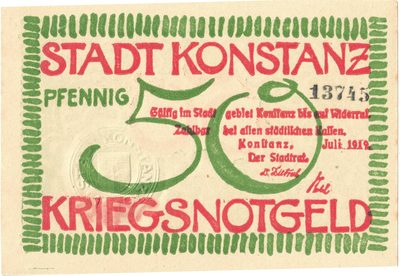
50 Pfennig, Stadt Konstanz, 1919
Kriegsnotgeld der Stadt Konstanz
What was happening
Notgeld - "emergency money" - began in 1914 out of necessity. The small coin vanished into hoards within weeks of mobilisation and the Reichsbank could not supply enough change, so towns and districts printed their own low-value notes to keep trade moving. The shortage outlasted the war itself: many towns went on issuing plain Kriegsnotgeld into 1919 and 1920, before the collector Serienscheine took over.
Konstanz (Constance) lies in the far south-west, in Baden, on the shore of the Bodensee (Lake Constance) where the Rhine leaves the lake, pressed up against the Swiss border. It is one of the oldest towns on the lake, famous above all as the seat of the Council of Constance of 1414-1418, the great church council that ended the Western Schism and condemned the reformer Jan Hus, who was burned here in 1415.
This note, issued by the town council (Der Stadtrat) in July 1919, is a plain piece of emergency change rather than a pictorial collector's note. It is headed "Stadt Konstanz / Kriegsnotgeld / 50 Pfennig", with an ornate green reverse and the serial number on the face. Though printed after the Armistice, it still carries the wartime label Kriegsnotgeld, a sign of how long the coin shortage persisted into the early Republic.