Types / 1921
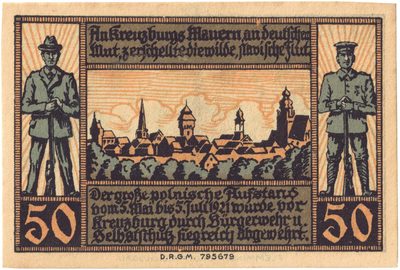
50 Pfennig, Stadt Kreuzburg in Oberschlesien, 1921
What was happening
Notgeld began in 1914 out of necessity: coin vanished into hoards within weeks of mobilisation and towns printed their own small change because the Reichsbank could not supply enough.
By 1920 it had become something else. The shortage was easing but the collector market was not, and a town could take real marks for paper it hoped would never be presented. So the municipalities commissioned Serienscheine: lithographed sets, printed far beyond any local need, illustrated with whatever the place was proud of - a legend, a famous son, a battle, a joke in dialect. The result is the most inventive body of graphic design in the history of paper money, made by places with a few thousand inhabitants, in the years when Germany's currency was dying.
The most directly political note in this collection. Kreuzburg in Upper Silesia printed it after the Third Silesian Uprising of May to July 1921, and the text is a victory claim: der große polnische Aufstand vom 5. Mai bis 5. Juli 1921 wurde vor Kreuzburg durch Bürgerwehr und Selbstschutz siegreich abgewehrt - the great Polish uprising was beaten off before Kreuzburg by the civil guard and the self-defence force.
Above it runs a line that is not a report but a slogan: an Kreuzburgs Mauern an deutschem Mut zerschellte die wilde, slavische Flut - on Kreuzburg's walls, on German courage, the wild Slavic flood was dashed to pieces.