Types / 1921
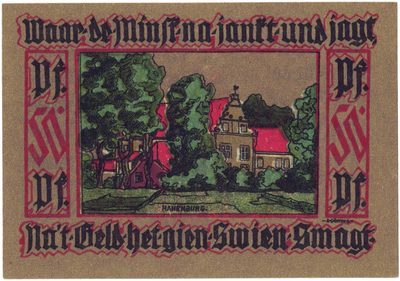
50 Pfennig, Leer in Ostfriesland, 1921
What was happening
Notgeld began in 1914 out of necessity: coin vanished into hoards within weeks of mobilisation and towns printed their own small change because the Reichsbank could not supply enough.
By 1920 it had become something else. The shortage was easing but the collector market was not, and a town could take real marks for paper it hoped would never be presented. So the municipalities commissioned Serienscheine: lithographed sets, printed far beyond any local need, illustrated with whatever the place was proud of - a legend, a famous son, a battle, a joke in dialect. The result is the most inventive body of graphic design in the history of paper money, made by places with a few thousand inhabitants, in the years when Germany's currency was dying.
Not the town but a society: the Verein für Heimatschutz und Heimatgeschichte of Leer in East Frisia issued this in October 1921 belt för de Tiet fan de Heimatwillen - struck for the time, for the sake of the homeland. A local-history association printing currency to fund itself is about as far from a treasury as Notgeld gets.
The Low German motto on the face is the best line in the batch: waar de Minsk na jankt un jagt, Nôtgeld het gien Swien smagt - whatever people whine and chase after, emergency money has never tasted good to any pig.