Types / 1921
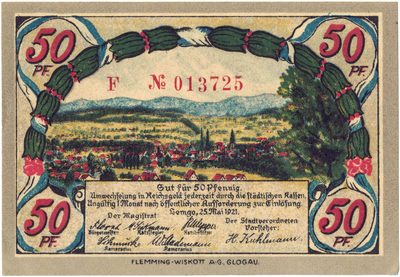
50 Pfennig, Stadt Lemgo, 1921
Gutschein der Stadt Lemgo
What was happening
Notgeld began in 1914 out of necessity: coin vanished into hoards within weeks of mobilisation and towns printed their own small change because the Reichsbank could not supply enough.
By 1920 it had become something else. The shortage was easing but the collector market was not, and a town could take real marks for paper it hoped would never be presented. So the municipalities commissioned Serienscheine: lithographed sets, printed far beyond any local need, illustrated with whatever the place was proud of - a legend, a famous son, a battle, a joke in dialect. The result is the most inventive body of graphic design in the history of paper money, made by places with a few thousand inhabitants, in the years when Germany's currency was dying.
Lemgo is an old Hanseatic town in the former principality of Lippe, laid out around 1190 and rich in houses of the Weser Renaissance - the regional Northern-Renaissance manner of carved stone gables and ornamented fronts. Its darker fame is the witch trials that ran from the late sixteenth century into the 1680s and sent more than two hundred people, men and women, to death; the town museum still keeps the merchant's house nicknamed the Hexenbürgermeisterhaus after the witch-hunting mayor Hermann Cothmann.
This 50-Pfennig value carries a garlanded oval town view on its face - "Gut für 50 Pfennig ... Der Magistrat" with its series letter and serial - and on the reverse a reclining figure in blue uniform with a verse to the old Hanseatic town. It belongs to the lettered Lemgo set with the [[notgeld-lemgo-10-pfennig]] and the Rathaus note, [[notgeld-lemgo-25-pfennig]].