Types / 1921
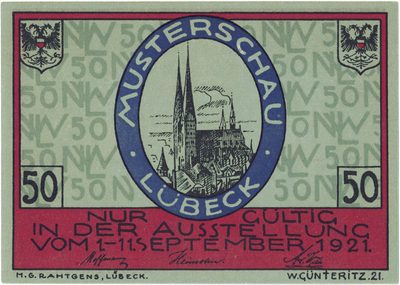
50 Pfennig, Nordische Woche Lübeck, 1921 (Schweden)
Musterschau Lübeck
What was happening
The Nordische Woche ("Nordic Week") was a cultural and trade exhibition held in Lübeck from 1 to 11 September 1921. The old Hanseatic city mounted it to revive its historic ties with Scandinavia after the First World War, presenting itself as Germany's gateway to the north; it coincided with the founding, in Lübeck the same year, of the Nordische Gesellschaft, the German-Nordic society that would make the city its seat. Art, craft and industry from Denmark, Sweden, Norway, Finland and the Baltic were shown alongside a commercial Musterschau (sample fair), and Alfred Mahlau's striking red-blue-and-black poster advertised the whole event.
These 50-Pfennig notes were the exhibition's own money, usable only on the grounds and valid only for the eleven days of the show. They were printed by H. G. Rahtgens of Lübeck to a design by W. Günteritz. Five pieces make up the set: all share a blue oval obverse showing the Musterschau Lübeck with the twin-spired Marienkirche rising over the city skyline, the Lübeck double-eagle arms set in the corners, and the value "50 / 50". Each reverse carries a different Nordic nation's flag and coat of arms beneath the split heading "Nordische Woche", distinguished by a control letter in place of a serial number.
This note, lettered B, is for Sweden: the yellow-on-blue Nordic-cross flag and the arms of Tre Kronor — three gold crowns on a blue field — the oldest and best-known Swedish emblem. The companion notes are [[notgeld-luebeck-nordische-woche-50-pfennig-luebeck]] (Lübeck), [[notgeld-luebeck-nordische-woche-50-pfennig-daenemark]] (Denmark), [[notgeld-luebeck-nordische-woche-50-pfennig-norwegen]] (Norway) and [[notgeld-luebeck-nordische-woche-50-pfennig-finnland]] (Finland).