Types / 1921
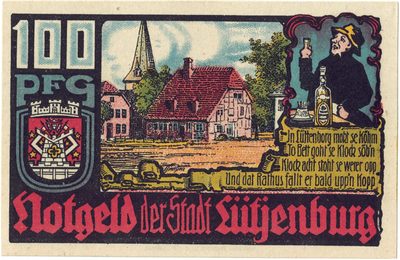
100 Pfennig, Stadt Lütjenburg, 1921
What was happening
Notgeld began in 1914 out of necessity: coin vanished into hoards within weeks of mobilisation and towns printed their own small change because the Reichsbank could not supply enough.
By 1920 it had become something else. The shortage was easing but the collector market was not, and a town could take real marks for paper it hoped would never be presented. So the municipalities commissioned Serienscheine: lithographed sets, printed far beyond any local need, illustrated with whatever the place was proud of - a legend, a famous son, a battle, a joke in dialect. The result is the most inventive body of graphic design in the history of paper money, made by places with a few thousand inhabitants, in the years when Germany's currency was dying.
The hundred is the funny one. A man in a top hat clutches a bottle beside a Low German verse: in Lütjenborg makt se Kähm, to Elf gohtse Klock söbn, Klock acht stoht se weer opp, und dat Rathus fallt er bald up'n Kopp - in Lütjenburg they brew Kümmel; at eleven they go to bed at seven, at eight they are up again, and the town hall will soon fall on their heads.