Types / 1920
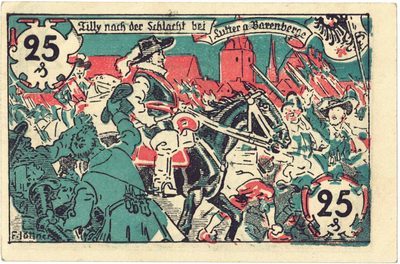
25 Pfennig, Volksbank zu Lutter am Barenberge, 1920
Anweisung der Volksbank zu Lutter am Barenberge
What was happening
Notgeld began in 1914 out of necessity: coin vanished into hoards within weeks of mobilisation and towns printed their own small change because the Reichsbank could not supply enough.
By 1920 it had become something else. The shortage was easing but the collector market was not, and a town could take real marks for paper it hoped would never be presented. So the municipalities commissioned Serienscheine: lithographed sets, printed far beyond any local need, illustrated with whatever the place was proud of - a legend, a famous son, a battle, a joke in dialect. The result is the most inventive body of graphic design in the history of paper money, made by places with a few thousand inhabitants, in the years when Germany's currency was dying.
Lutter am Barenberge is a village in the Brunswick country at the northern edge of the Harz, and its whole claim on history is one afternoon. On 27 August 1626 Tilly, commanding the army of the Catholic League, destroyed the Danish army of Christian IV here. The defeat ended Danish intervention in the Thirty Years' War, broke the Protestant cause in Lower Saxony and opened northern Germany to the imperial armies.
The notes were issued not by the village but by its cooperative bank - the Volksbank zu Lutter am Barenberge e.G.m.u.H. - on 30 December 1920, good only für den Wirkungskreis dieser Bank und Sparkasse: within the working area of this bank and savings bank. That is a narrower circulation than any town boundary in this collection.
All three were drawn by F. Jüttner, who also drew the Braunschweig transport company's note and the Brocken innkeeper's voucher. Between them they run the battle as a sequence: the rout, the victor, and the aftermath.
This is the 25 Pfennig, captioned Tilly nach der Schlacht bei Lutter a. Barenberge. It shows Tilly riding forward through the wreck of the field in a wide-brimmed hat, pikes and banners behind him and the village church on the skyline, cut in green and red.