Types / 1921
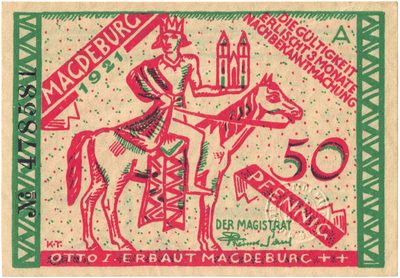
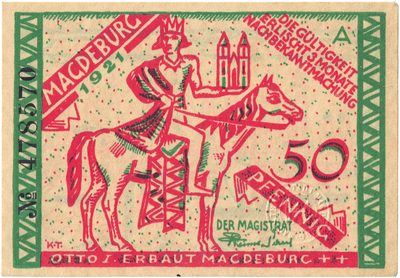
50 Pfennig, Stadt Magdeburg, 1921 (Alt-Magdeburg)
Notgeld der Stadt Magdeburg
What was happening
Notgeld began in 1914 out of necessity: coin vanished into hoards within weeks of mobilisation and towns printed their own small change because the Reichsbank could not supply enough.
By 1920 it had become something else. The shortage was easing but the collector market was not, and a town could take real marks for paper it hoped would never be presented. So the municipalities commissioned Serienscheine: lithographed sets, printed far beyond any local need, illustrated with whatever the place was proud of. The result is the most inventive body of graphic design in the history of paper money, made in the years when Germany's currency was dying.
Magdeburg's 1921 notes are among the most startling objects in the whole of German Notgeld: flat, jagged, splintered designs in red and green, made at the moment Bruno Taut (1880-1938) arrived as the city's architect and set about painting the old town in violent colour. The set pairs an Alt- and a Neu-Magdeburg - the old city and the modern vision of it.
This note is the Alt-Magdeburg half. The face is the Magdeburger Reiter, the thirteenth-century equestrian statue traditionally identified with Otto I, redrawn as faceted planes and captioned Otto I. erbaut Magdeburg - Otto the Great, who made Magdeburg his seat and is buried in its cathedral, claimed as the first builder of the city. It carries a serial and a boxed series letter "A." The reverse is the old city on the river, over the line Alt-Magdeburg am Elbestrand - ein stolzes Bild aus deutschem Land. Its companion is the forward-looking [[notgeld-magdeburg-50-pfennig]] with the Neu-Magdeburg reverse of cranes and aeroplanes; see also [[notgeld-magdeburg-25-pfennig]].