Types / 1920
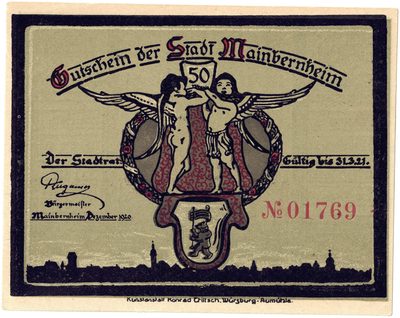
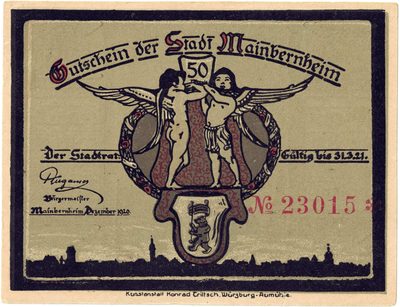
50 Pfennig, Stadt Mainbernheim, 1920
Gutschein der Stadt Mainbernheim
What was happening
Notgeld began in 1914 out of necessity: coin vanished into hoards within weeks of mobilisation and towns printed their own small change because the Reichsbank could not supply enough.
By 1920 it had become something else. The shortage was easing but the collector market was not, and a town could take real marks for paper it hoped would never be presented. So the municipalities commissioned Serienscheine: lithographed sets, printed far beyond any local need, illustrated with whatever the place was proud of - a legend, a famous son, a battle, a joke in dialect. The result is the most inventive body of graphic design in the history of paper money, made by places with a few thousand inhabitants, in the years when Germany's currency was dying.
Mainbernheim is a small walled town in the Kitzingen district of Lower Franconia, Bavaria. A former Reichsdorf granted town rights in 1382 and later enclosed with a wall and moat, it kept its fortifications almost whole - a near-complete circuit with two gate towers and a ring of wall towers - and that ring is what the town put on its money. The fifty's reverse shows one of the Mainbernheim towers, red-roofed above a cluster of half-timbered houses and the old town wall, framed by the civic proverb Wenn jeder dem andern helfen wollte, wäre allen geholfen ("if everyone were willing to help the next, everyone would be helped"). The face sets two winged genii holding a "50" tablet above the civic lion shield and a silhouette of the town. Dated "Mainbernheim, Dezember 1920" and valid to 31 March 1921, signed for the Stadtrat by the Bürgermeister.