Types / 1921
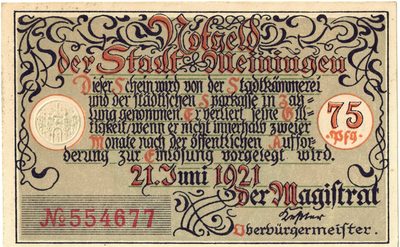
75 Pfennig, Stadt Meiningen, 1921
What was happening
Notgeld began in 1914 out of necessity: coin vanished into hoards within weeks of mobilisation and towns printed their own small change because the Reichsbank could not supply enough.
By 1920 it had become something else. The shortage was easing but the collector market was not, and a town could take real marks for paper it hoped would never be presented. So the municipalities commissioned Serienscheine: lithographed sets, printed far beyond any local need, illustrated with whatever the place was proud of - a legend, a famous son, a battle, a joke in dialect. The result is the most inventive body of graphic design in the history of paper money, made by places with a few thousand inhabitants, in the years when Germany's currency was dying.
Meiningen was the residence of the Dukes of Saxe-Meiningen, and its court theatre under Duke Georg II was the most influential company in nineteenth-century Europe - the Meininger invented the modern idea of a director. The town's 1921 notes are quieter than that suggests: the gate with its hen, the old market school, and a good deal of ornamental lettering.
The seventy-five leaves the gate for a lost building: the alte Marktschule, demolished in 1848, drawn as a tall half-timbered house on a busy street, with the dialect line jont is niß meä uhmüglich - nothing is impossible any more.