Types / 1920
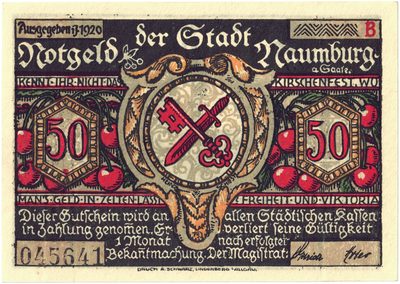
50 Pfennig, Stadt Naumburg an der Saale, 1920 (Kirschfest)
Notgeld der Stadt Naumburg a. Saale
What was happening
Notgeld began in 1914 out of necessity: coin vanished into hoards within weeks of mobilisation and towns printed their own small change because the Reichsbank could not supply enough.
By 1920 it had become something else. The shortage was easing but the collector market was not, and a town could take real marks for paper it hoped would never be presented. So the municipalities commissioned Serienscheine: lithographed sets, printed far beyond any local need, illustrated with whatever the place was proud of - a legend, a famous son, a battle, a joke in dialect. The result is the most inventive body of graphic design in the history of paper money, made in the years when Germany's currency was dying.
Naumburg on the Saale is a cathedral city - the Naumburg Dom, with its celebrated Uta statue, is a UNESCO World Heritage Site. But the scene this note tells is the town's own Kirschfest, the cherry festival, and the legend attached to it. The story holds that in 1432 a Hussite army under Procopius lay before the walls, that the townsfolk, with no hope of defending themselves, sent out their children to plead for mercy, and that the commander, moved, spared the town and gave the children cherries. Historians treat the siege as unproven - the cathedral's own records say the Hussites were never at Naumburg, and the tale seems to have grown up around a much older school festival - but the festival and its legend are what the town celebrates, and what the note commemorates.
This 50-Pfennig value, issued July 1920 and printed by G. Schwarz of Lindenberg im Allgäu, carries on its face the town arms of crossed keys and sword wreathed in cherries, with a serial and a boxed series letter "B"; the reverse is a Hussite silhouette carrying the verse of the Kirschfest.