Types / 1921
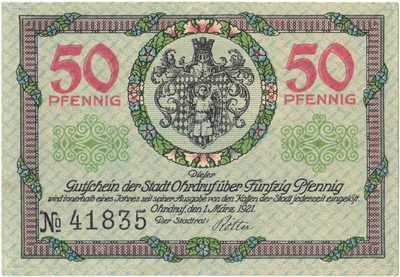
50 Pfennig, Stadt Ohrdruf, 1921
Gutschein der Stadt Ohrdruf
What was happening
Notgeld began in 1914 out of necessity: coin vanished into hoards within weeks of mobilisation, and towns printed their own small change because the Reichsbank could not supply enough.
By 1920 it had become something else as well: a collector's object. The shortage was easing but the market was not, and towns issued illustrated paper far beyond any local need, printed by firms that specialised in the trade.
Ohrdruf is an old town in Thuringia, at the northern foot of the Thuringian Forest. Its roots are monastic - St Boniface is said to have founded the first monastery in Thuringia here in the 720s - and its landmark is Schloss Ehrenstein, a Renaissance palace begun in 1550 by the Counts of Gleichen on the site of that early foundation. Ohrdruf's lasting fame, though, is musical: the orphaned ten-year-old Johann Sebastian Bach came here in 1695 to live with his elder brother Johann Christoph, organist of St Michael's, and went to the Lyceum in the town until about 1700 - his first schooling and his first serious contact with keyboard music.
This 50-Pfennig note reads "Gutschein der Stadt Ohrdruf über Fünfzig Pfennig," issued by the Stadtrat and dated 1 March 1921, with the town arms on the front and the serial number there; its back shows a castle and landscape - Schloss Ehrenstein. It was printed by Gebr. Paschl in Munich.