Types / 1921
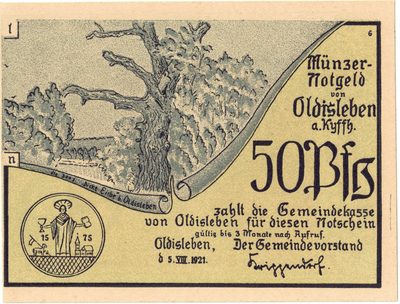
50 Pfennig, Gemeinde Oldisleben, 1921 (Münzer-Notgeld, the oak)
Münzer-Notgeld von Oldisleben a. Kyffh.
What was happening
Oldisleben lies by the Kyffhäuser in northern Thuringia, close to Bad Frankenhausen. Its 1921 emergency money is titled Münzer-Notgeld — a double pun, on Münze ("coin, money") and on Thomas Müntzer, the radical reformer whose peasant army was destroyed just up the road. The whole series is themed on the German Peasants' War of 1525.
Thomas Müntzer (c. 1489–1525) was the apocalyptic preacher who led the revolutionary wing of the Peasants' War and broke bitterly with Luther. On 15 May 1525 the princes — Philip of Hesse, Duke George of Saxony and Count Ernst von Mansfeld — fell on the peasants' wagon-fort outside Frankenhausen and massacred some six thousand of them; a rainbow Müntzer had taken as a sign of divine protection did not save them. Survivors fled into the town of Frankenhausen, where the killing went on. Müntzer was captured there, taken to the Mansfeld stronghold of Heldrungen, tortured, and beheaded near Mühlhausen on 27 May 1525.
This 50-Pfennig note's front shows the "500jährige dicke Eiche b. Oldisleben" — a 500-year-old oak near the village — beside the old seal of Oldisleben's former Benedictine monastery (a monk, the Lamb of God and the abbey church, dated 1575). It is valid until three months after being called in, dated 5 August 1921, over the signature of the parish council; printed by Karl Naumburg of Kindelbrück. The reverse shows a burning town with fleeing figures under the banner Die geschlagenen Bauern fliehen in d. Stadt Frankenhausen — "the defeated peasants flee into the town of Frankenhausen."