Types / 1921
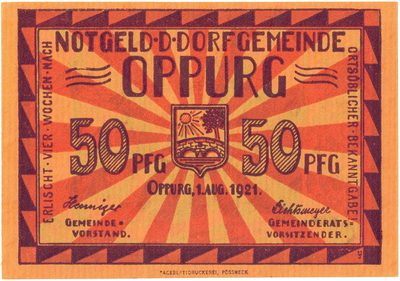
50 Pfennig, Dorfgemeinde Oppurg, 1921 (the church)
Notgeld der Dorfgemeinde Oppurg
What was happening
Notgeld began in 1914 out of necessity: coin vanished into hoards within weeks of mobilisation and towns printed their own small change because the Reichsbank could not supply enough.
By 1920 it had become something else. The shortage was easing but the collector market was not, and a town could take real marks for paper it hoped would never be presented. So the municipalities commissioned Serienscheine: lithographed sets, printed far beyond any local need, illustrated with whatever the place was proud of. The result is the most inventive body of graphic design in the history of paper money, made in the years when Germany's currency was dying.
Oppurg is a village in Thuringia on the Orla, just below Pössneck, best known for its Wasserschloss - a moated manor-house. Even a village of its size issued a little set of three notes: all share the same obverse, a sunburst behind the town arms, and each differs in the colour of its paper and in the scene on its back. The notes were printed at the Tageblatt press in Pössneck and dated "Oppurg, 1. Aug. 1921."
This 50 Pfennig value shows on its reverse the village church beside a great tree, captioned "Kirche erb. 1694" - the parish church built in 1694. See the two companion notes, the [[notgeld-oppurg-50-pfennig-tuerkenhof]] and the [[notgeld-oppurg-75-pfennig-schlossturm]].