Types / 1921
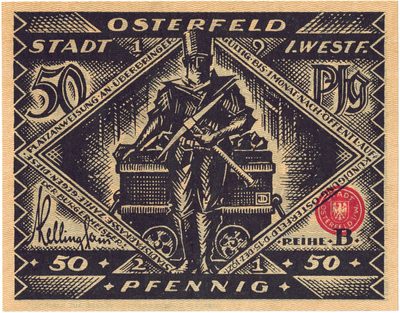
50 Pfennig, Stadt Osterfeld, 1921
Stadt Osterfeld i. Westf.
What was happening
Notgeld began in 1914 out of necessity: coin vanished into hoards within weeks of mobilisation and towns printed their own small change because the Reichsbank could not supply enough.
By 1920 it had become something else. The shortage was easing but the collector market was not, and an issuer could take real marks for paper it hoped would never be presented. So towns, firms and clubs commissioned Serienscheine: lithographed sets, printed far beyond any local need, illustrated with whatever the place was proud of - a legend, a famous son, a battle, a trade, a joke in dialect. The result is the most inventive body of graphic design in the history of paper money, made in the years when Germany's currency was dying.
Osterfeld was a coal-mining town north of the Emscher in the Ruhr. In 1929 it lost its independence, absorbed into Oberhausen together with Sterkrade to make 'Gross-Oberhausen' - and the horse-trading over which bigger neighbour would swallow it is exactly what this note jokes about.
The back shows top-hatted figures against a colliery skyline, one clutching a paper reading Gross-Oberhausen, under a verse that has Bottrop and Sterkrade rushing to act the moment they heard, lest someone else get this particular roast. (The rivalry is the note's own self-mocking civic humour.) The note is a Platzanweisung, Reihe B, cashable at the town savings bank.