Types / 1921
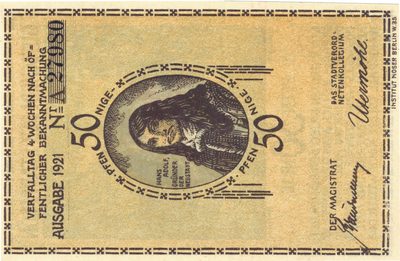
50 Pfennig, Stadt Plön, 1921 (Hans Adolf / church)
Gutschein der Stadt Plön
What was happening
Notgeld began in 1914 out of necessity: coin vanished into hoards within weeks of mobilisation and towns printed their own small change because the Reichsbank could not supply enough.
By 1920 it had become something else. The shortage was easing but the collector market was not, and a town could take real marks for paper it hoped would never be presented. So the municipalities commissioned Serienscheine: lithographed sets printed far beyond any local need and illustrated with whatever the place was proud of - a legend, a famous son, a building, a trade, a joke in dialect. The result is the most inventive body of graphic design in the history of paper money, made in the years when Germany's currency was dying.
Plön is a small Holstein town set among the lakes of the Holsteinische Schweiz, built on the narrows between the Kleiner and the Großer Plöner See, the largest lake in Schleswig-Holstein. Above it stands the white Schloss Plön, the seventeenth-century residence of the former dukes of Holstein-Plön and the only hilltop castle in the province. The town issued this Serienschein, signed by Der Magistrat and Das Stadtverordnetenkollegium (Utermöhl), with Low-German verse.
This 50-Pfennig note bears on the obverse a portrait of "Hans Adolf, Gründer der Neustadt" - Duke Hans Adolf (Johann Adolf) of Holstein-Plön (1634-1704), remembered as the founder of the Neustadt, the newer quarter of the town - and on the reverse a lakeside church. Its companion is the 25-Pfennig value; see [[notgeld-ploen-25-pfennig-fischerei]].