Types / 1921
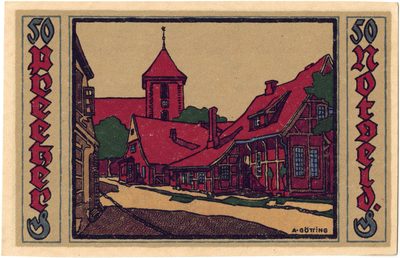
50 Pfennig, Stadt Preetz, 1921 (church street)
Notgeld der Stadt Preetz in Holstein
What was happening
Notgeld - "emergency money". German towns, districts and firms began printing their own small change in 1914, when metal coin vanished into hoards, and did not really stop until the 1923 stabilisation.
What began as necessity became a craze. By 1921 municipalities were commissioning Serienscheine: beautifully lithographed series aimed squarely at collectors, printed far beyond any local need, illustrated with local legends, landmarks and jokes in dialect. Selling them to collectors was itself a way of raising money - the town took real marks for paper it hoped would never be redeemed.
Preetz, a small Holstein town east of Kiel grown up around a Benedictine nunnery, issued a set of six 50-Pfennig notes in April 1921, each carrying a different view of the place. This one shows a street under the tower of the town church, a run of steep red-tiled roofs falling away toward the foreground - a quiet townscape drawn in flat lithographic colour and signed in the plate by the artist A. Goetting. The reverse is given over to a large interlaced "50" with the town's swan arms, the denomination spelled out, and the usual clause that the note lapses once the town calls it in.