Types / 1921
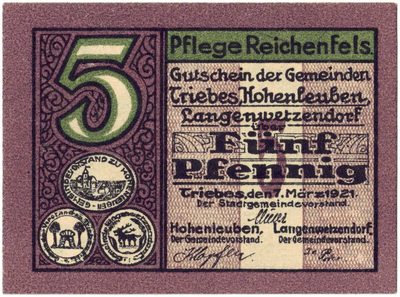
5 Pfennig, Pflege Reichenfels, 1921
Pflege Reichenfels
What was happening
Notgeld began in 1914 out of necessity: coin vanished into hoards within weeks of mobilisation and towns printed their own small change because the Reichsbank could not supply enough.
By 1920 it had become something else. The shortage was easing but the collector market was not, and a town could take real marks for paper it hoped would never be presented. So the municipalities commissioned Serienscheine: lithographed sets, printed far beyond any local need, illustrated with whatever the place was proud of. The result is the most inventive body of graphic design in the history of paper money, made in the years when Germany's currency was dying.
The Pflege Reichenfels was a small historic territory in the Vogtland of eastern Thuringia, a Pflege (bailiwick) administered from Burg Reichenfels, the castle on a wooded hill above Hohenleuben; castle and Pflege are both first recorded in 1356, under the Vögte of Gera. This note is part of a joint issue of three neighbouring communes - Triebes, Hohenleuben and Langenwetzendorf - put out together under the revived name Pflege Reichenfels, by the Triebes Stadtgemeindevorstand, dated Triebes, den 7. März 1921, with no serial number. Its reverse shows Burg Reichenfels on its wooded hill above a four-line verse that names the partner places in Vogtland dialect spelling - "...Triebs, Leim, Weizendorf..." (Triebes, Hohenleuben, Langenwetzendorf). The set runs [[notgeld-reichenfels-1-pfennig]] and [[notgeld-reichenfels-10-pfennig]].