Types / 1921
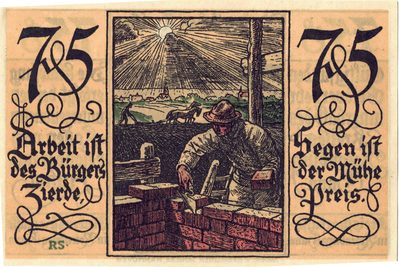
75 Pfennig, District of Rotenburg in Hanover, 1921
Notgeld des Kreises Rotenburg i. Hann.
What was happening
Notgeld - "emergency money". German towns, districts and firms began printing their own small change in 1914, when silver and nickel coin disappeared into hoards within weeks of mobilisation, and did not really stop until the stabilisation of 1923.
What began as necessity turned into a craze. By 1920 municipalities were commissioning Serienscheine: lithographed sets aimed squarely at collectors, printed far beyond any local need, illustrated with local legends, landmarks, famous sons and jokes in dialect. Selling them was itself a way of raising money - the town took real marks for notes it hoped would never be presented for redemption. The result is the most inventive body of graphic design in the history of paper money, produced by places with a few thousand inhabitants.
Rotenburg lies on the Wuemme between Hamburg and Bremen, in the heath country. Its district note is dated 1 January 1921, numbered, and redeemable at the two named savings banks - the district savings bank and the Fleckenssparkasse, the savings bank of the market village.
A seventy-five Pfennig denomination is the signature of a Serienschein. Nothing costs seventy-five pfennig; the value exists so that a set of notes is a set. The design is a thatched Lower Saxon farmhouse under trees, and the two side panels carry a couplet from Schiller's Song of the Bell:
Arbeit ist des Buergers Zierde, Segen ist der Muehe Preis.
Work is the citizen's adornment, blessing is the reward of effort. It is printed on a piece of paper that a district issued because the national currency had failed, and the second face shows a bricklayer building a wall in the sun.