Types / 1921
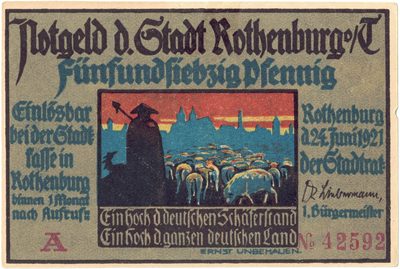
75 Pfennig, Stadt Rothenburg ob der Tauber, 1921 (shepherd couple)
Notgeld der Stadt Rothenburg o/T
What was happening
Notgeld began in 1914 out of necessity: coin vanished into hoards within weeks of mobilisation and towns printed their own small change because the Reichsbank could not supply enough.
By 1920 it had become something else. The shortage was easing but the collector market was not, and a town could take real marks for paper it hoped would never be presented. So the municipalities commissioned Serienscheine: lithographed sets, printed far beyond any local need, illustrated with whatever the place was proud of - a legend, a famous son, a custom in dialect. The result is the most inventive body of graphic design in the history of paper money, made in the years when Germany's currency was dying.
Rothenburg ob der Tauber, the walled Franconian town above the Tauber, built its set around its own living custom: the Schäfertanz, the shepherds' dance. By tradition the shepherds' guild held the right to dance in costume on the market square, a privilege the legend traces to shepherds who had saved the town - from the plague, in the common telling. The costumed dance was revived in 1911 and became the town's signature festival, danced around the Renaissance fountain on the Marktplatz. The notes were drawn by Ernst Unbehauen and carry verse in the local Franconian dialect.
This note is series letter A, dated "Rothenburg, 24. Juni 1921." Its face shows a shepherd and his partner in folk costume under an arch, with a dialect verse ("Dann hüet i halt mei Betzeli..."), and small corner figures - one riding a goose, one a ram. See the companion note, the standing head-shepherd design, [[notgeld-rothenburg-75-pfennig-oberschaefer]].