Types / 1920
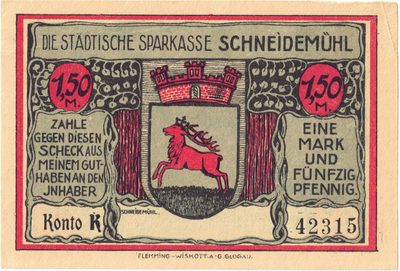
1,50 Mark, Staedtische Sparkasse Schneidemuehl, 1920
Die Staedtische Sparkasse Schneidemuehl
What was happening
By 1920 German Notgeld had stopped being a response to a coin shortage and become a collector's product. Towns, districts and firms commissioned decorative Serienscheine - lithographed sets printed far beyond any local need and sold to collectors, illustrated with whatever the place was proud of: a legend, a famous son, a battle, a trade, a joke in dialect. The result is the most inventive body of graphic design in the history of paper money, made in the years when Germany's currency was dying.
Schneidemuehl (today Pila) was the chief town of the Grenzmark, the strip of Posen-West Prussia left to Germany when most of the province passed to Poland in 1920. This note, drawn as a cheque on the municipal savings bank for one mark and fifty pfennig, remembers the night in 1806 when, after the catastrophe of Jena and Auerstedt, Queen Louise of Prussia fled east through the town; the reverse shows the house Wohnung der Koenigin Luise waehrend ihrer Flucht - the lodging of Queen Louise during her flight. The leaping stag in the arms is the town's own.