Types / 1921
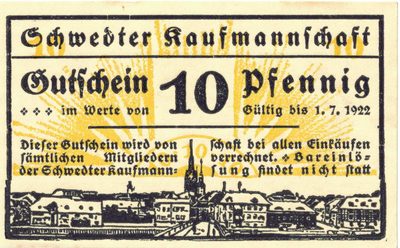
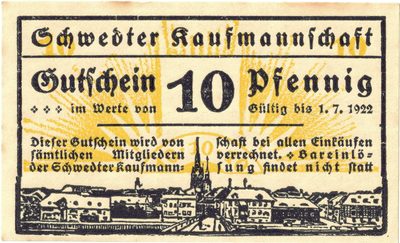
10 Pfennig, Schwedter Kaufmannschaft, 1921
Schwedter Kaufmannschaft
What was happening
By 1920 German Notgeld had stopped being a response to a coin shortage and become a collector's product. Towns, districts and firms commissioned decorative Serienscheine - lithographed sets printed far beyond any local need and sold to collectors, illustrated with whatever the place was proud of: a legend, a famous son, a battle, a trade, a joke in dialect. The result is the most inventive body of graphic design in the history of paper money, made in the years when Germany's currency was dying.
This small note was issued not by the town but by the Schwedter Kaufmannschaft, the merchants' association of Schwedt an der Oder in the Uckermark - a town long built on tobacco growing and trade. A voucher worth 10 Pfennig, good until 1 July 1922, with a view of the town across the Oder. Issues by trade guilds and chambers of commerce sit alongside municipal Notgeld through the inflation years.