Types / 1921
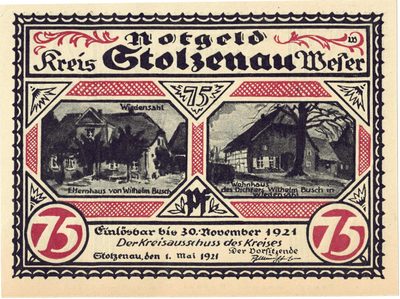
75 Pfennig, Kreis Stolzenau, 1921 (Wilhelm Busch)
Notgeld Kreis Stolzenau Weser
What was happening
Notgeld began in 1914 out of necessity: coin vanished into hoards within weeks of mobilisation and towns printed their own small change because the Reichsbank could not supply enough.
By 1920 it had become something else. The shortage was easing but the collector market was not, and an issuer could take real marks for paper it hoped would never be presented. So towns, firms and clubs commissioned Serienscheine: lithographed sets, printed far beyond any local need, illustrated with whatever the place was proud of - a legend, a famous son, a battle, a trade, a joke in dialect. The result is the most inventive body of graphic design in the history of paper money, made in the years when Germany's currency was dying.
The Kreis Stolzenau was a Prussian district on the Weser in the Province of Hanover, seat the little town of Stolzenau; it was merged into the Landkreis Nienburg/Weser in 1932. Its claim to fame is the village of Wiedensahl, where Wilhelm Busch - creator of Max und Moritz and a founder of the comic strip - was born in 1832.
The district's Notgeld makes the most of him. The note shows Busch's birth house and his later home at Wiedensahl, and carries his own couplet Doch guter Menschen Hauptbestreben / ist, andern auch was abzugeben - the chief aim of good people is to give something to others too - from Balduin Baehlamm, der verhinderte Dichter (1883), an apt motto for a voucher.