Types / 1921
50 Pfennig, Gemeinde Suchsdorf, 1921 (the drawbridge)
Notgeld der Gemeinde Suchsdorf
What was happening
By 1920 German Notgeld had stopped being a response to a coin shortage and become a collector's product. Towns, districts and firms commissioned decorative Serienscheine - lithographed sets printed far beyond any local need and sold to collectors, illustrated with whatever the place was proud of: a legend, a battle, a local worthy, a joke in dialect.
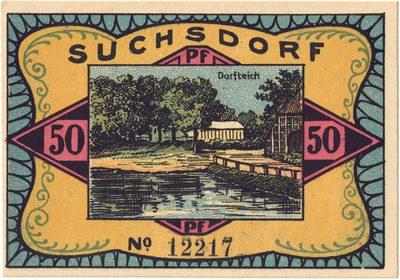
Suchsdorf, now a northern suburb of Kiel on the bank of the Kiel Canal (and an independent municipality until 1958), issued its 1921 Notgeld in the aftermath of the 1920 Schleswig plebiscite, and the set is as nationalist as any in this collection, carrying Schleswig-Holstein's lions and the blunt slogans of a border that had just been redrawn. The notes were valid until 31 August 1921. The shared face shows the village pond, the Dorfteich, with "Suchsdorf 50 Pf" and the serial number; the companion in the collection is [[notgeld-suchsdorf-50-pfennig]], the oak-and-arms "1864" note.
This note's pictorial side turns the Second Schleswig War of 1864 into a local anecdote. It shows a drawbridge raised against a troop of mounted men, under the line Nachdem die Bauern die Schlagbrücke passiert hatten, zog Brückenwärter "Leutnant Block" die Brücke hoch - "after the farmers had crossed the drawbridge, the bridge-keeper 'Lieutenant Block' hauled the bridge up." The story is told as local tradition rather than documented history: a bridge-keeper who, by raising his span at the right moment, held up an advancing column - the kind of homely war-tale a border village was glad to put on its money.