Types / 1921
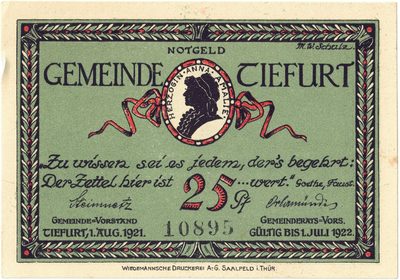
25 Pfennig, Gemeinde Tiefurt, 1921 (the park)
Notgeld der Gemeinde Tiefurt
What was happening
Notgeld began in 1914 out of necessity: coin vanished into hoards within weeks of mobilisation, and towns printed their own small change because the Reichsbank could not supply enough.
By 1920 it had become something else. The shortage was easing but the collector market was not, and a town could take real marks for paper it hoped would never be presented. So the municipalities commissioned Serienscheine: lithographed sets, printed far beyond any local need, illustrated with whatever the place was proud of. The result is the most inventive body of graphic design in the history of paper money, made in the years when Germany's currency was dying.
Tiefurt is a small village on the Ilm just outside Weimar. In 1781 the widowed Duchess Anna Amalia of Saxe-Weimar took it as her summer retreat, and over the next quarter-century she turned the modest manor and its grounds into one of the most famous Musenhöfe (courts of the muses) in Germany - a place where Goethe, Wieland and Herder gathered, where plays were performed in the open air and a literary journal was circulated in manuscript. The landscaped park along the river, dotted with poetic monuments, is the heart of the place.
All of Tiefurt's notes share a green front carrying the words "Gemeinde Tiefurt / Notgeld", a profile portrait medallion, and a Goethean legend - "Zu wissen sei es jedem, der's begehrt: Der Zettel hier ist 25 Pf wert" ("let it be known to all who wish it: this slip here is worth 25 Pf"); they were printed by the Wiedemann press in Saalfeld. This smallest value shows on its back a sepia view of the Tiefurt park and house. See the companion notes, the [[notgeld-tiefurt-50-pfennig-denkmal]], the [[notgeld-tiefurt-50-pfennig-park]] and the [[notgeld-tiefurt-75-pfennig-wieland]].