Types / 1921
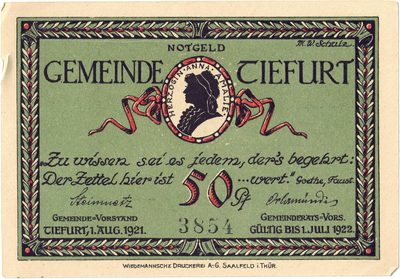
50 Pfennig, Gemeinde Tiefurt, 1921 (the monument)
Notgeld der Gemeinde Tiefurt
What was happening
Notgeld began in 1914 out of necessity: coin vanished into hoards within weeks of mobilisation, and towns printed their own small change because the Reichsbank could not supply enough.
By 1920 it had become something else. The shortage was easing but the collector market was not, and a town could take real marks for paper it hoped would never be presented. So the municipalities commissioned Serienscheine: lithographed sets, printed far beyond any local need, illustrated with whatever the place was proud of. The result is the most inventive body of graphic design in the history of paper money, made in the years when Germany's currency was dying.
Tiefurt, a village on the Ilm just outside Weimar, became in 1781 the summer retreat of the widowed Duchess Anna Amalia of Saxe-Weimar, who made its manor and grounds a famous Musenhof - a court of the muses around Goethe, Wieland and Herder. Among the poetic monuments she had set in the park are a temple of the muses, a Mozart monument, the Herder stone, a cenotaph for her son Constantin, and a memorial to a Prince Leopold.
This note shows on its back such a park monument - an urn captioned "Dem verewigten Leopold" ("to the immortalised Leopold") - carrying a patriotic verse. The wording is read off the note and plainly dates from the First World War rather than from Anna Amalia's day: "Stürzt auch in Kriegesflammen Deutschlands Kaiserreich zusammen, deutsche Größe bleibt bestehen" ("though Germany's empire collapse in the flames of war, German greatness endures"). All of Tiefurt's notes share the same green front - "Gemeinde Tiefurt / Notgeld", a profile medallion and the Goethean legend "Der Zettel hier ist 50 Pf wert" - and were printed by the Wiedemann press in Saalfeld. See the companion notes, the [[notgeld-tiefurt-25-pfennig-park]], the [[notgeld-tiefurt-50-pfennig-park]] and the [[notgeld-tiefurt-75-pfennig-wieland]].