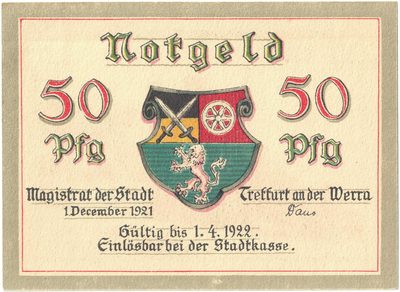
Types / 1921
50 Pfennig, Stadt Treffurt, 1921 (the Normannstein)
Notgeld der Stadt Treffurt
What was happening
Notgeld began in 1914 out of necessity: coin vanished into hoards within weeks of mobilisation, and towns printed their own small change because the Reichsbank could not supply enough.
By 1920 it had become something else. The shortage was easing but the collector market was not, and a town could take real marks for paper it hoped would never be presented. So the municipalities commissioned Serienscheine: lithographed sets, printed far beyond any local need, illustrated with whatever the place was proud of. The result is the most inventive body of graphic design in the history of paper money, made in the years when Germany's currency was dying.
Treffurt is a small half-timbered town on the Werra, at the old meeting-point of Thuringia, Hesse and Saxony. Above it, on a rocky spur perhaps a hundred metres over the town, stands the ruin of the Normannstein, the castle that has watched over Treffurt since the 11th or 12th century. It was the seat of the lords of Treffurt, who by about 1300 had turned robber knight and were driven out after sieges in 1333 and 1336; the castle and town were then governed for centuries as a Ganerbschaft, a joint lordship shared between Electoral Mainz, Hesse and Saxony. The ruin is still the landmark of the place.
This note is one of a set of 50-Pfennig Serienscheine that share a common front - the green town arms and the words "Notgeld / 50 Pfg" - and differ in the coloured town view on the back. Here the back shows the wooded crag above the river crowned by the Normannstein. See the companion notes, the [[notgeld-treffurt-50-pfennig-werra]], the [[notgeld-treffurt-50-pfennig-kirche]] and the [[notgeld-treffurt-50-pfennig-gasse]].