Types / 1921
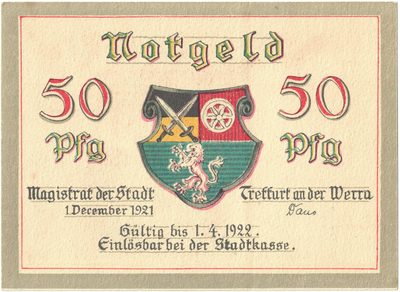
50 Pfennig, Stadt Treffurt, 1921 (the Werra)
Notgeld der Stadt Treffurt
What was happening
Notgeld began in 1914 out of necessity: coin vanished into hoards within weeks of mobilisation, and towns printed their own small change because the Reichsbank could not supply enough.
By 1920 it had become something else. The shortage was easing but the collector market was not, and a town could take real marks for paper it hoped would never be presented. So the municipalities commissioned Serienscheine: lithographed sets, printed far beyond any local need, illustrated with whatever the place was proud of. The result is the most inventive body of graphic design in the history of paper money, made in the years when Germany's currency was dying.
Treffurt is a small half-timbered town on the Werra, at the old meeting-point of Thuringia, Hesse and Saxony. Its name is usually derived from the three fords (drei Furten) by which the river was crossed here. The town issued a set of 50-Pfennig notes that share a common front - the green town arms (a lion with a crossed staff and a wheel) beside the words "Notgeld / 50 Pfg", signed "Haus" - and differ only in the coloured town view on the back, each after a photograph credited to "Ortsaufnahme Arthur Kirchner, Erfurt". The notes were dated 1 December 1921 and valid until 1 April 1922.
This value shows the red-roofed houses of the old town standing along the bank of the Werra. See the companion notes, the [[notgeld-treffurt-50-pfennig-normannstein]], the [[notgeld-treffurt-50-pfennig-kirche]] and the [[notgeld-treffurt-50-pfennig-gasse]].