Types / 1921
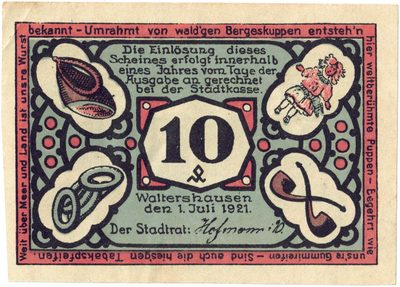
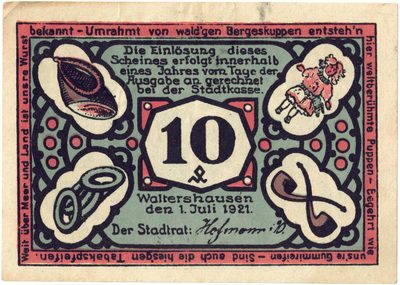
10 Pfennig, Stadt Waltershausen, 1921
Waltershausen i. Th.
What was happening
Notgeld began in 1914 out of necessity: coin vanished into hoards within weeks of mobilisation and towns printed their own small change because the Reichsbank could not supply enough.
By 1920 it had become something else. The shortage was easing but the collector market was not, and a town could take real marks for paper it hoped would never be presented. So the municipalities commissioned Serienscheine: lithographed sets, printed far beyond any local need, illustrated with whatever the place was proud of - a legend, a famous son, a battle, a joke in dialect. The result is the most inventive body of graphic design in the history of paper money, made in the years when Germany's currency was dying.
Waltershausen was Germany's doll town. Johann Daniel Kestner brought papier-mâché doll manufacture here in the early nineteenth century, and from 1885 the firm of Kämmer & Reinhardt - whose bisque character dolls won prizes at Chicago in 1893 and St. Louis in 1904 - made the place the acknowledged capital of the trade. This 10-Pfennig note is the town advertising itself. The obverse frames the figure "10" with four vignettes of the local trades the town lived by - dolls and puppets, tobacco pipes, rubber tyres and sausage - under a rhymed boast that begins "Umrahmt von wald'gen Bergeskuppen entsteh'n hier weltberühmte Puppen..." ("Ringed by wooded hilltops, world-famous dolls are made here..."). The reverse carries a panoramic view of Waltershausen after the artist R. Dürkel, with the serial number. Dated Waltershausen, den 1. Juli 1921. The town's smaller note is [[notgeld-waltershausen-5-pfennig]].