Types / 1922
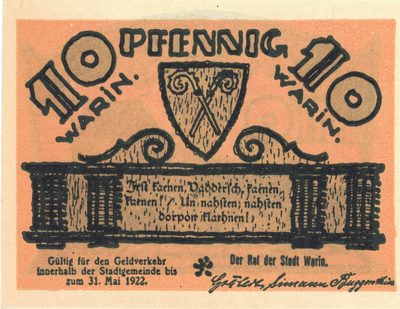
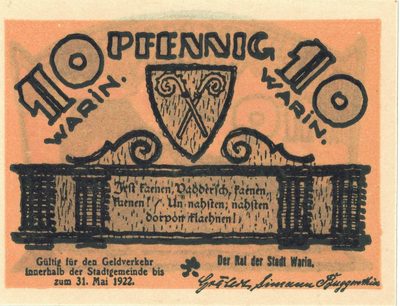
10 Pfennig, Stadt Warin, 1922
Reutergeld der Stadt Warin
What was happening
Notgeld - emergency money - began in 1914 when coin disappeared into hoards, but by the early 1920s it had turned into something close to a craze. The real shortage had eased, yet towns kept printing lithographed Serienscheine in colourful sets, far more than any local trade required, because collectors paid good marks for them. Even a small place could sell its own paper money and illustrate it with whatever it was proud of.
Warin is a little town in Mecklenburg, between Schwerin and Wismar, and its 1922 issue is the Reutergeld der Stadt Warin. The name is a tribute to Fritz Reuter (1810-1874), the great Mecklenburg poet who wrote in Plattdeutsch, Low German; the notes accordingly carry Low German verses rather than plain legends. They were orange lithographs, declared valid für den Geldverkehr innerhalb der Stadtgemeinde bis zum 31. Mai 1922 and issued by Der Rat der Stadt Warin - the town council. They carry no serial numbers.
This ten-Pfennig note leads with a large 10 PFENNIG and the town arms, whose bishop's crozier recalls that Warin once belonged to the bishopric of Schwerin. A Low German verse runs in a scroll across the face, and the reverse shows a half-timbered building under the caption Reutergeld Stadt Warin. Printed by the Bärensprungsche Hofbuchdruckerei in Schwerin, it is a typical product of the dialect-proud, album-bound Serienschein years.