Types / 1921
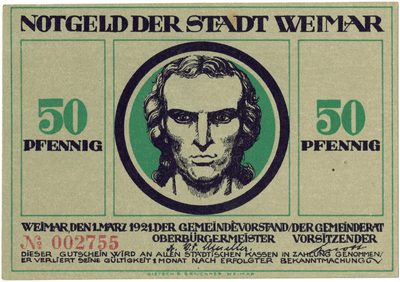
50 Pfennig, Stadt Weimar, 1921 (Schiller — "Lieben Freunde")
Notgeld der Stadt Weimar
What was happening
Notgeld began in 1914 out of necessity: coin vanished into hoards within weeks of mobilisation and towns printed their own small change because the Reichsbank could not supply enough.
By 1920 it had become something else. The shortage was easing but the collector market was not, and a town could take real marks for paper it hoped would never be presented. So the municipalities commissioned Serienscheine: lithographed sets, printed far beyond any local need, illustrated with whatever the place was proud of - a legend, a famous son, a battle, a joke in dialect. The result is the most inventive body of graphic design in the history of paper money, made in the years when Germany's currency was dying.
No German town had more to put on its money than Weimar. Goethe lived here from 1775 until his death in 1832 and Schiller from 1799 until his in 1805; between them they made the little Thuringian residence-town the capital of German letters, and the bronze pair by Ernst Rietschel still stand hand in hand before the theatre where, in 1919, the National Assembly had just written the constitution that gave the Republic its name. This 50-Pfennig set - lithographed by Dietsch & Brückner of Weimar and dated "Weimar, den 1. März 1921" - makes the whole series an anthology: each note carries an engraved portrait of one of the two poets on the face and, on the back in its own colour, an allegorical scene paired with a verse.
This note, printed in green, shows the young Schiller in a circular roundel. The reverse is a Bacchic scene of grapevine and fruit under the opening couplet of Schiller's poem An die Freunde - a wry toast to friends that better times than the present once existed. The sentiment landed hard on paper money issued in the first inflation year. Its companion Schiller notes are [[notgeld-weimar-50-pfennig-schiller-schuldbuch]] and [[notgeld-weimar-50-pfennig-schiller-hoffnung]]; the Goethe faces of the set are [[notgeld-weimar-50-pfennig-goethe-kette]], [[notgeld-weimar-50-pfennig-goethe-edel]] and [[notgeld-weimar-50-pfennig-goethe-krieg]].