Types / 1917
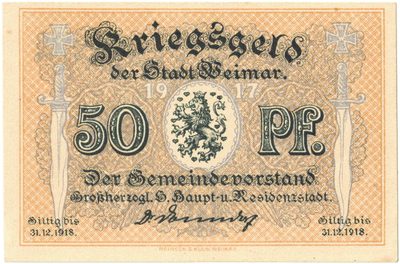
50 Pfennig, Stadt Weimar, 1917
Kriegsgeld der Stadt Weimar
What was happening
Notgeld - "emergency money" - began in 1914 out of necessity. Within weeks of mobilisation the small silver and copper coin vanished into hoards, and the Reichsbank could not supply enough change for everyday trade, so towns, districts and firms printed their own low-value notes to keep shops and wage packets working. This austere wartime money is called Kriegsnotgeld to set it apart from the lavish collector Serienscheine that appeared only after 1920.
Weimar, the little Thuringian residence-town of the Grand Dukes of Saxe-Weimar-Eisenach, had been the capital of German letters since Goethe and Schiller worked there around 1800. But this note has nothing of that: it is a plain piece of wartime change, headed "Kriegsgeld der Stadt Weimar", dated 1917 and declared valid only to 31 December 1918. It carries the Weimar lion emblem, the value "50 Pf", and the signature of the municipal authority (Der Gemeindevorstand), with the serial number on the face.
It should not be confused with the famous Weimar collector set of 1921, lithographed by Dietsch & Brückner, whose notes pair engraved portraits of Goethe and Schiller with allegorical scenes and quoted verse - see [[notgeld-weimar-50-pfennig-goethe-edel]] and its companions. That set was art for album pages; this 1917 note is the real wartime currency it was made to look back on.