Types / 1921
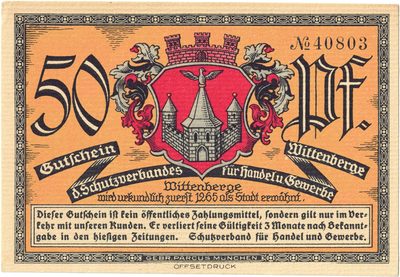
50 Pfennig, Wittenberge, 1921 (Neue Bürgerschule)
Gutschein des Schutzverbandes für Handel und Gewerbe Wittenberge
What was happening
Notgeld began in 1914 out of necessity: coin vanished into hoards within weeks of mobilisation and towns printed their own small change because the Reichsbank could not supply enough.
By 1920 it had become something else. The shortage was easing but the collector market was not, and an issuer could take real marks for paper it hoped would never be presented. So towns, firms and clubs commissioned Serienscheine: lithographed sets, printed far beyond any local need, illustrated with whatever the place was proud of - a legend, a famous son, a building, a view. The result is the most inventive body of graphic design in the history of paper money, made in the years when Germany's currency was dying.
Wittenberge is a town in the Prignitz, on the right bank of the Elbe in the north-west corner of Brandenburg - an industrial place, known for its railway works, its oil mill and its Singer sewing-machine factory. This 50-Pfennig set was issued not by the city but by the Schutzverband für Handel und Gewerbe - the local trade and commerce protective association - as a Gutschein redeemable only among its member businesses and expressly not legal tender. Every note carries the Wittenberge civic arms and the proud line Wittenberge wird urkundlich zuerst 1265 als Stadt erwähnt - Wittenberge is first documented as a town in 1265 - and the reverses show the town building by building, in offset by Gebr. Parcus of Munich.
This note shows the Neue Bürgerschule, the new municipal elementary school. It belongs to the set of six with the [[notgeld-wittenberge-50-pfennig-rathaus]], [[notgeld-wittenberge-50-pfennig-lyceum]], [[notgeld-wittenberge-50-pfennig-elbbruecke]], [[notgeld-wittenberge-50-pfennig-alter-turm]] and [[notgeld-wittenberge-50-pfennig-realgymnasium]].