Types / 1920
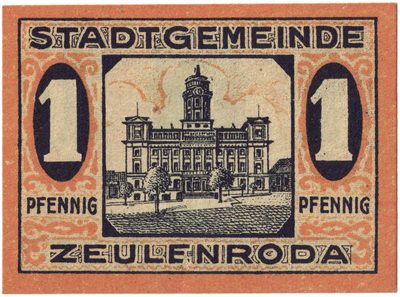
1 Pfennig, Stadt Zeulenroda, 1920
Stadtgemeinde Zeulenroda
What was happening
Notgeld began in 1914 out of necessity: coin vanished into hoards within weeks of mobilisation and towns printed their own small change because the Reichsbank could not supply enough.
By 1920 it had become something else. The shortage was easing but the collector market was not, and a town could take real marks for paper it hoped would never be presented. So the municipalities commissioned Serienscheine: lithographed sets, printed far beyond any local need, illustrated with whatever the place was proud of - a legend, a famous son, a building. The result is the most inventive body of graphic design in the history of paper money, made in the years when Germany's currency was dying.
Zeulenroda is a small town in the Vogtland corner of eastern Thuringia (district of Greiz), long known for its furniture-making. This smallest of denominations, a single pfennig, puts the town's pride on the paper: the obverse shows the Rathaus, Zeulenroda's dignified classical town hall, beside the value "1 Pfennig". The reverse shows a lion-headed fountain-spout (a mascaron) set in a brick niche, with the words Ein Pfennig. The note is issued by the Stadtgemeinde Zeulenroda, dated Zeulenroda, den 1. Jan. 1920 and signed by the mayor W. John, Oberbürgermeister. It carries no serial number.