Types / 1920
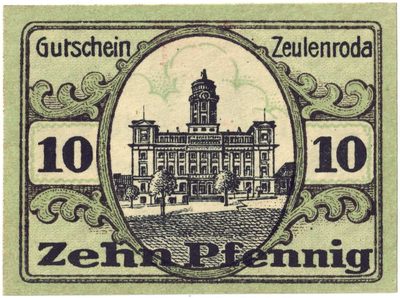
10 Pfennig, Stadt Zeulenroda, 1920
Gutschein der Stadt Zeulenroda
What was happening
Notgeld began in 1914 out of necessity: coin vanished into hoards within weeks of mobilisation, and towns printed their own small change because the Reichsbank could not supply enough.
By 1920 it had become something else as well: a collector's object. The shortage was easing but the market was not, and towns issued illustrated paper far beyond any local need. Zeulenroda is a small town in the Vogtland corner of eastern Thuringia, in the old principality of Reuss, long known for its weaving and button-making; it issued several such notes in the early 1920s.
This 10-Pfennig note is the earliest of them, still part of the genuine small-change shortage: it is dated 11 January 1920 and reads "Gutschein Zeulenroda / Zehn Pfennig", issued by the Stadtgemeindevorstand over the signature of the Oberbürgermeister. The front shows the town's dignified classical Rathaus; the back shows a building with a figure. It was printed by Otto Henning in nearby Greiz. See the smallest value, the [[notgeld-zeulenroda-1-pfennig]], and the later 1921 issues, the [[notgeld-zeulenroda-25-pfennig]] and the [[notgeld-zeulenroda-75-pfennig]].