Types / 1921
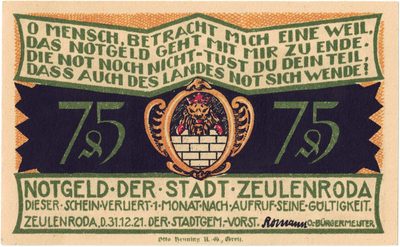
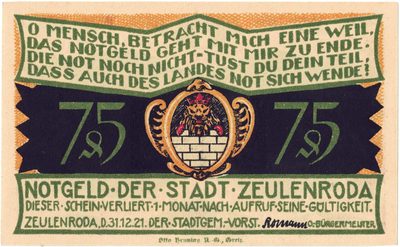
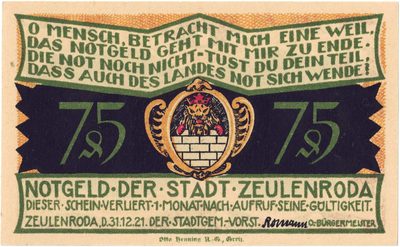
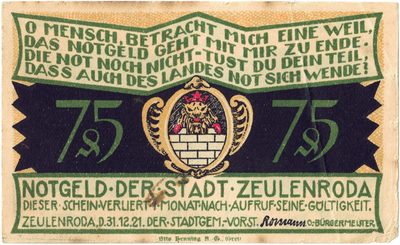
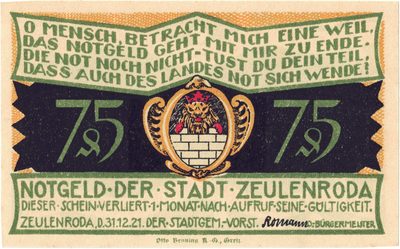
75 Pfennig, Stadt Zeulenroda, 1921 (the flood)
Notgeld der Stadt Zeulenroda
What was happening
Notgeld began in 1914 out of necessity: coin vanished into hoards within weeks of mobilisation, and towns printed their own small change because the Reichsbank could not supply enough.
By 1920 it had become something else. The shortage was easing but the collector market was not, and a town could take real marks for paper it hoped would never be presented. So the municipalities commissioned Serienscheine: lithographed sets illustrated with whatever the place was proud of - or whatever it had suffered.
Zeulenroda, a weaving and button-making town in the Vogtland corner of eastern Thuringia (the old principality of Reuss), sits in the hilly country of the Weiße Elster and had been struck more than once by flooding. Its 1921 notes share a front with the town arms (a crowned lion's head over a brick wall) and the verse "O Mensch, betracht mich eine Weil, das Notgeld geht mit mir zu Ende, die Not noch nicht - tust du dein Teil, daß auch des Landes Not sich wende!"
This 75-Pfennig value, dated to the end of 1921, carries on its back a Wassernot - a flood and the labour of recovery - with a verse recalling a disaster twelve years before: "12 Jahr ist's, daß die Wassernot die Leidige überwunden ... Geb Gott, daß auch von seiner Not mag Deutschland bald gesunden" ("twelve years it is since the grievous flood was overcome ... God grant that from its own distress Germany too may soon recover"). Reckoned back from 1921 the verse points to a flood of 1909; the detail is attested here chiefly by the note itself, and the wider floods of February 1909 across Saxony and Thuringia make it plausible. It was printed by Otto Henning in nearby Greiz. The companion [[notgeld-zeulenroda-25-pfennig]] carries the matching fire (Feuersnot) scene; see also the [[notgeld-zeulenroda-10-pfennig]] and the [[notgeld-zeulenroda-1-pfennig]].