Types / 1921
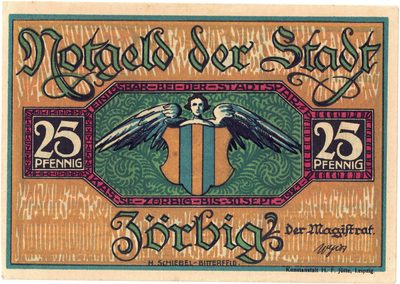
25 Pfennig, Stadt Zörbig, 1921 (Oskar Fleischer)
Notgeld der Stadt Zörbig
What was happening
By 1920 German Notgeld had become a collector's product. Towns commissioned decorative Serienscheine - lithographed sets printed far beyond any local need and sold to collectors, illustrated with whatever the place was proud of. Zörbig, a small town in Anhalt (today Saxony-Anhalt) and an early centre of German tobacco-growing, built its 1921 series around its notable sons. Each note shares a face of a winged genius holding the town's blue-and-gold striped shield, Notgeld der Stadt Zörbig / 25 Pfennig, and carries on the back a portrait and short biography of a local worthy, a Roman series numeral and the Zörbig skyline, under the motto So helfen wir uns mit Papier - "thus we help ourselves with paper." The notes were designed by H. Schiebel and printed at Bitterfeld in 1921.
This note honours Oskar Fleischer, the musicologist, born in Zörbig in 1856 (the note gives his birth as 2 November 1856). He studied languages and philosophy at Halle, took a doctorate with a dissertation on Notker Labeo, and then turned to musicology in Berlin under Philipp Spitta. From 1888 he directed and catalogued the royal collection of musical instruments in Berlin, and from 1895 to 1925 he taught as an associate professor of musicology at the University of Berlin, where his students included Hermann Abert, Curt Sachs and the Armenian composer Komitas.
In 1899 Fleischer helped found the Internationale Musikgesellschaft (International Music Society) and served as its first president. His research centred on medieval systems of musical notation - the neumes, Byzantine notation among them - and he contributed to the early comparative musicology that would grow into ethnomusicology. He died in Berlin in 1933.