Types / 1921
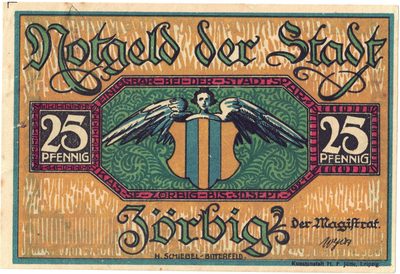
25 Pfennig, Stadt Zörbig, 1921 (Johann Jakob Reiske)
Notgeld der Stadt Zörbig
What was happening
By 1920 German Notgeld had become a collector's product. Towns commissioned decorative Serienscheine - lithographed sets printed far beyond any local need and sold to collectors, illustrated with whatever the place was proud of. Zörbig, a small town in Anhalt (today Saxony-Anhalt) and an early centre of German tobacco-growing, built its 1921 series around its notable sons. Each note shares a face of a winged genius holding the town's blue-and-gold striped shield, Notgeld der Stadt Zörbig / 25 Pfennig, and carries on the back a portrait and short biography of a local worthy, a Roman series numeral and the Zörbig skyline, under the motto So helfen wir uns mit Papier - "thus we help ourselves with paper." The notes were designed by H. Schiebel and printed at Bitterfeld in 1921.
This note honours Johann Jakob Reiske, born in Zörbig on 25 December 1716, the son of a tanner. One of the greatest philologists of the eighteenth century, Reiske was a pioneer of Arabic and Byzantine studies: largely self-taught in Arabic, he spent years in Leiden editing pre-Islamic Arabic poetry (notably the Mu'allaqa of Tarafa), and his work founded Arabic philology as an independent discipline at Leipzig while also advancing Byzantine Greek scholarship and Islamic numismatics.
Reiske lived in great poverty as a student - he is said to have spent on Arabic books whatever he could save from his food - and found recognition slow in coming. He became rector of the Nikolaischule in Leipzig, where he died on 14 August 1774; several of his works were published after his death by his wife, Ernestine Christine. A town could hardly claim a more distinguished scholar, and the note's "the greatest philologist of the eighteenth century" is a fair reflection of his modern standing.